Drawabox Review: Does It Really Change Your Art? (Before and After)
Drawabox is a free online course in drawing fundamentals with a reputation for being both effective and demanding. People search for it in every spelling, from “drawabox” to “draw abox” and “drawa box”, and very often with “before and after” attached, because they want to know one thing: does it actually change your art? This review explains what the course teaches, how it’s structured, what’s free and what’s paid, who it suits, and where to see real before and after work. Every fact about the course comes from drawabox.com, checked in November 2026. We don’t show screenshots of the site; the drawings on this page are our own ink versions of the exercise types.
What is Drawabox?
According to its own Lesson 0, Drawabox is “at its core, a community of people developing their drawing skills”, built around free lessons. The lessons were written by the site’s founder, who goes by Uncomfortable, and were originally built on what he learned from Peter Han’s Dynamic Sketching course at Concept Design Academy in 2013. On the About page, he describes himself as working at a game studio, where he was hired as a concept artist and illustrator.
The project is older than the website. The About page says it started as the /r/ArtFundamentals community on Reddit in August 2014, became the drawabox.com website in March 2015, and gained a Discord server in October 2017. The site’s footer shows it’s still run by Drawabox Art Instruction Inc. as of 2026, and the lessons are still being updated.
The goal is specific: Drawabox teaches you to make drawings feel solid and three-dimensional. It’s not a course in color, painting or finished illustration.
How the course is structured
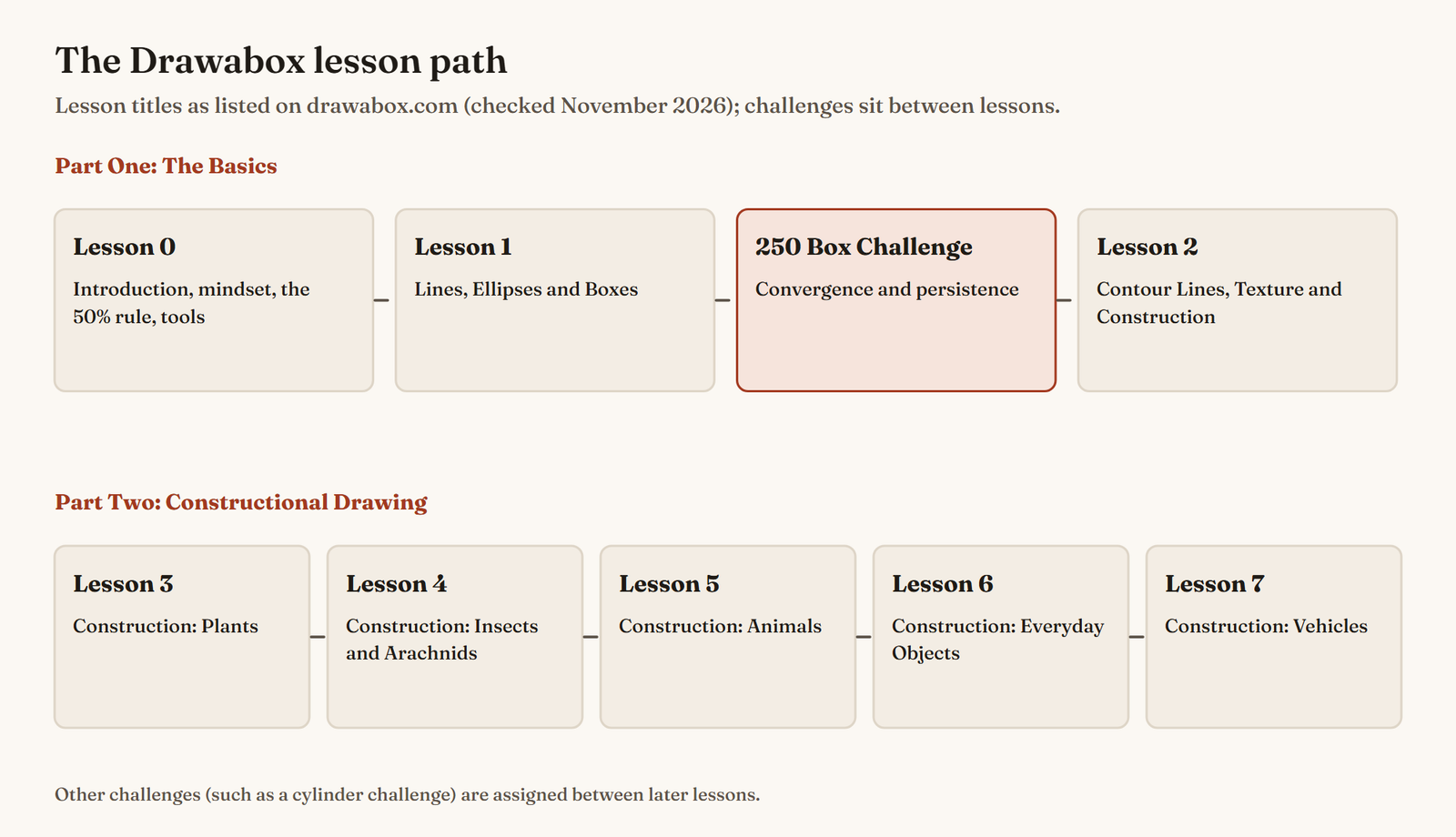
The lessons page splits the course into two parts. Part One: The Basics covers technical and conceptual skills you’ll keep using as warm-ups. Part Two: Constructional Drawing applies one idea, breaking complex objects into simple forms and rebuilding them, to a series of subjects. As listed on the site in November 2026:
- Lesson 0: introduction, mindset, the 50% rule, how to use the course and the recommended tools.
- Lesson 1: Lines, Ellipses and Boxes.
- Lesson 2: Contour Lines, Texture and Construction.
- Lesson 3: Applying Construction to Plants.
- Lesson 4: Applying Construction to Insects and Arachnids.
- Lesson 5: Applying Construction to Animals.
- Lesson 6: Applying Construction to Everyday Objects.
- Lesson 7: Applying Construction to Vehicles.
Challenges and drills sit between the lessons. The site notes that they aren’t meant to be done all at once after Lesson 2; each is listed as a next step or prerequisite as you go. The lesson path diagram at the top of this page shows the order.
How to work through the lessons
The draw a box lessons are designed to be followed in order, and the site’s own advice favors steady, spread-out practice over marathons. A sensible approach for most people:
- Read Lesson 0 fully, including the 50% rule and the section on getting feedback. It sets expectations for everything that follows.
- Do the homework as written. Resist the temptation to skip exercises you find dull; they’re usually the ones that fix your weakest skills.
- Use warm-ups. Lesson 0 recommends warming up with earlier exercises before each session, so old skills stay sharp.
- Post your work. Whether you use free community feedback or paid official critique, getting another set of eyes on your homework is part of the method.
- Keep a separate sketchbook for fun, so the 50% rule is easy to follow.
Most of all, judge progress over months, not days. Construction skills improve slowly and then suddenly show up in everything you draw.
The exercises: lines, ellipses, boxes and forms
The early lessons are built from a handful of exercise types. These are our own ink drawings of what they look like, not copies of the course’s images.
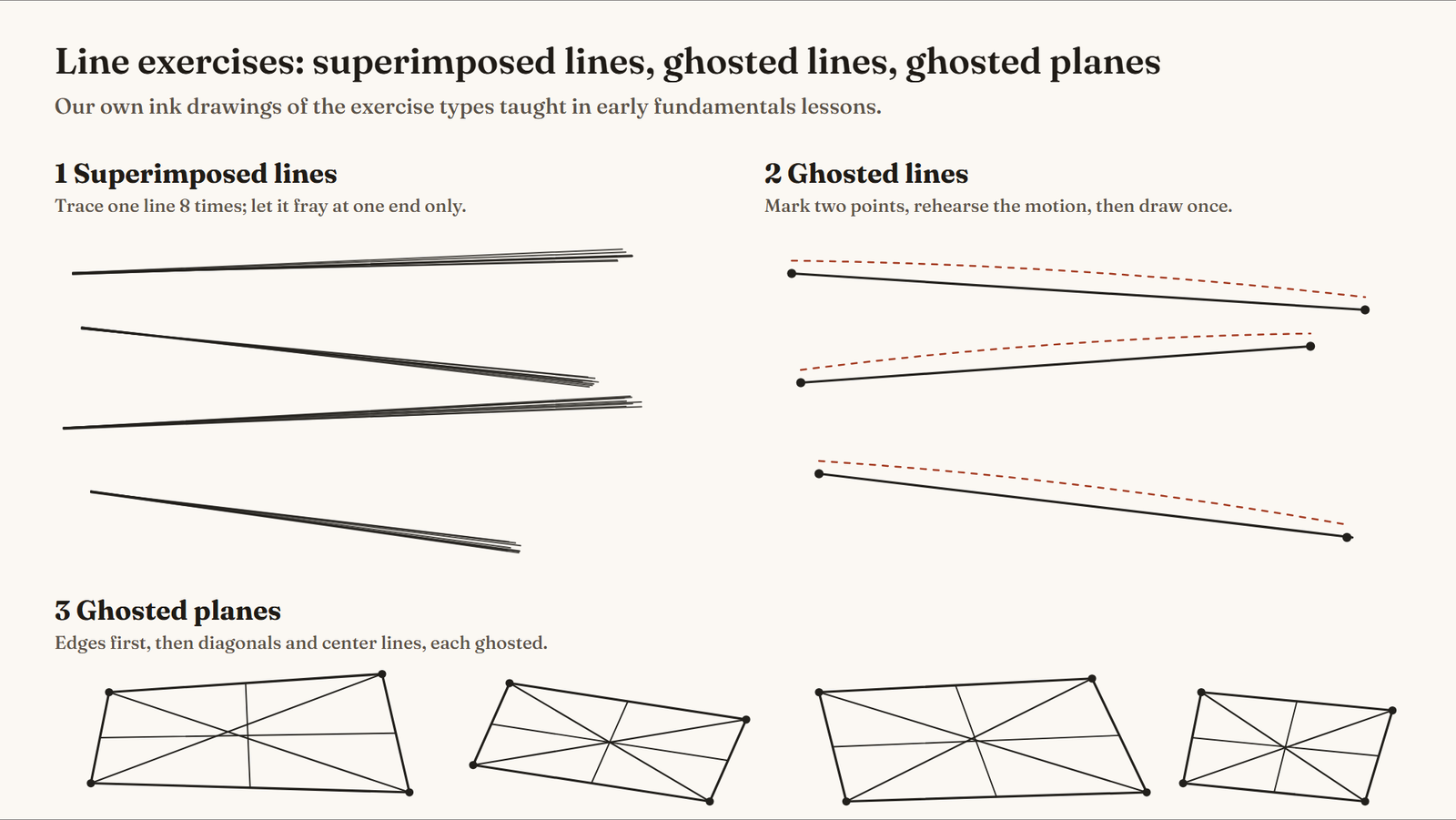
- Superimposed lines: tracing the same line several times so you learn to draw from the shoulder with a consistent stroke.
- Ghosted lines and planes: marking start and end points, rehearsing the motion, then drawing the line once with confidence. Planes add diagonals and center lines.
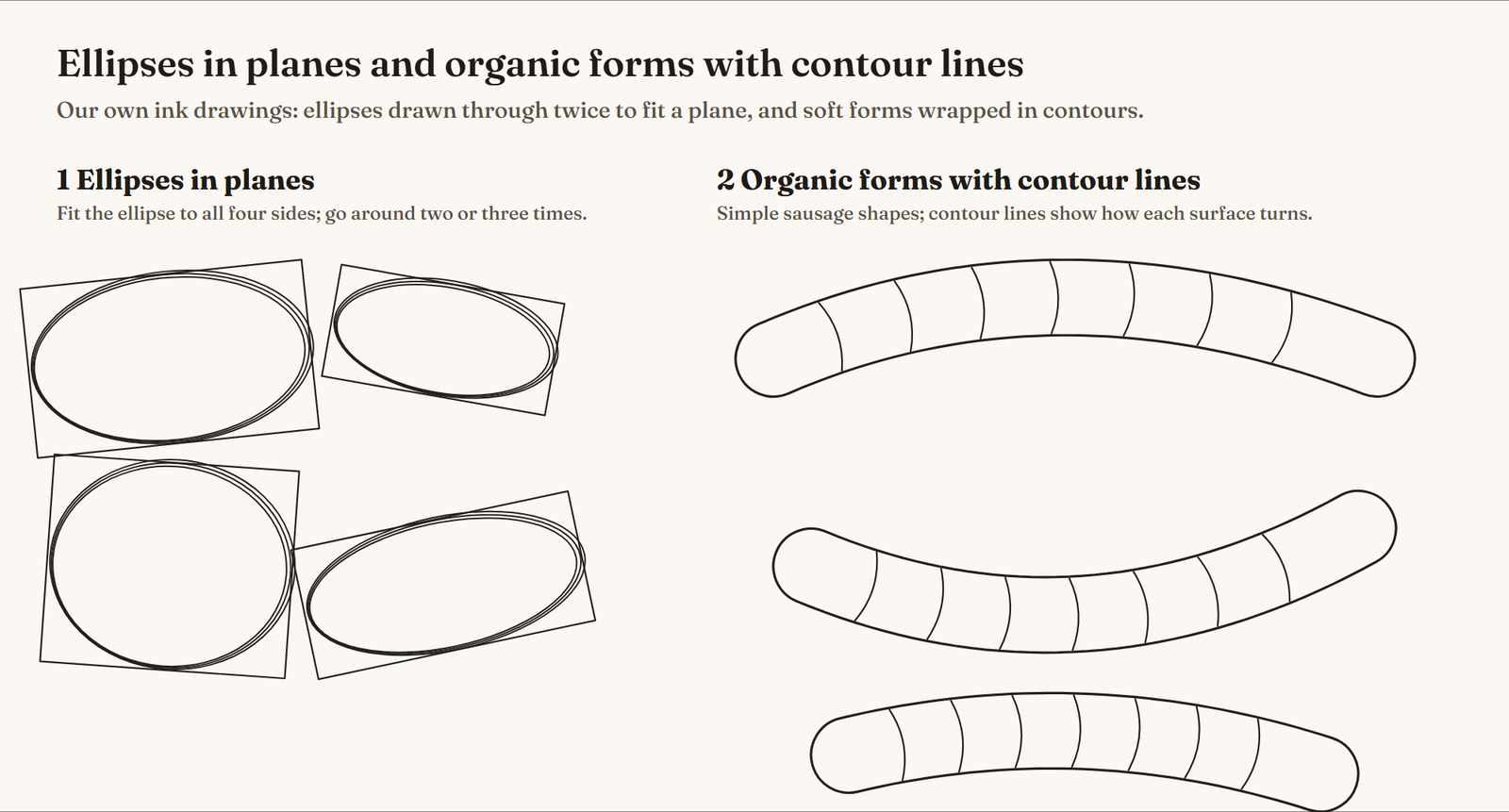
- Ellipses: drawn through two or three times, fitted inside planes.
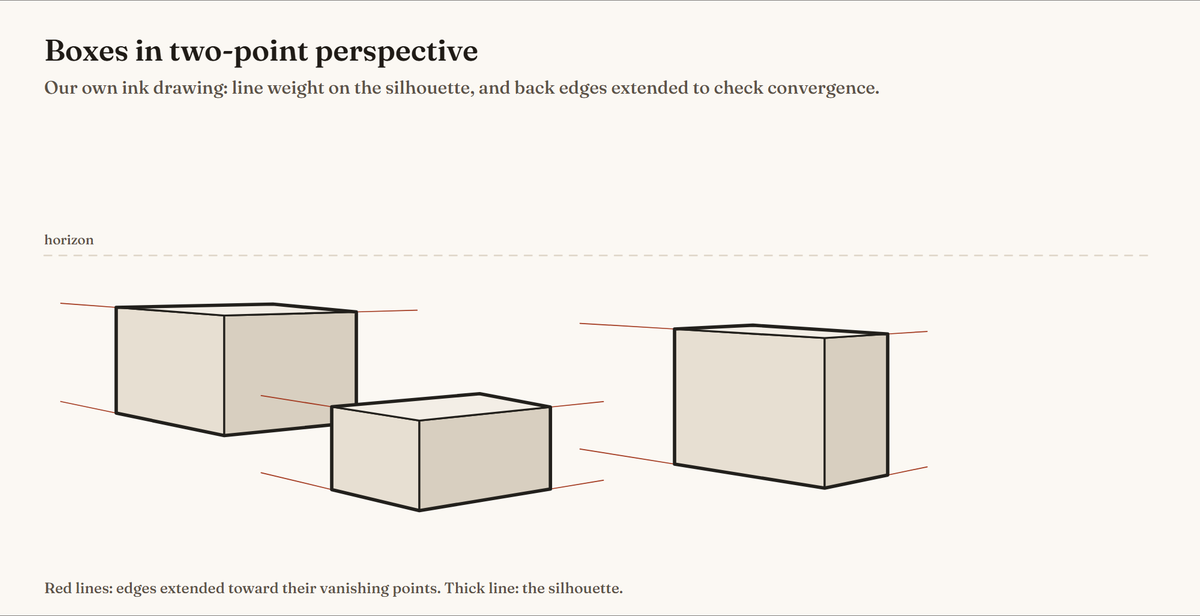
- Boxes: drawn in perspective, with their edges extended to check whether they converge correctly.
- Organic forms with contour lines: soft, sausage-like forms wrapped in contour lines that describe how the surface turns in space.
The course asks for these exercises in ink, which removes the option to erase and forces you to plan each mark. That’s a big part of what it trains: confidence and decision-making, not just accuracy.
The 250 Box Challenge
The most famous part of Drawabox is the 250 Box Challenge. The site describes it as “a daunting, but conquerable task” and a bootcamp for judging and estimating how the edges of a box converge. It also says the challenge teaches something about persistence: tackling a large, overwhelming task by breaking it into smaller steps and spreading it out over time.
It comes after Lesson 1, and the site is clear that it relies on Lesson 1’s concepts and on the mindset and balance from Lesson 0. If you haven’t done those, you aren’t ready for it. In practice, it’s where many students either commit to the course or decide it isn’t for them.
The 50% rule
One of the most distinctive parts of the course isn’t an exercise at all. Lesson 0 asks every student to follow the 50% rule: at most half of your drawing time can go to study (including the Drawabox homework), and at least half must be spent drawing for its own sake. The site explains that the point isn’t necessarily to have fun, but to develop the ability to enjoy drawing that doesn’t produce a polished result. It frames the rule as protecting your mental health and motivation over a long course.
For anyone worried that Drawabox is all drills, this matters: the course explicitly expects you to keep drawing whatever you like alongside the homework.
Free vs paid: community feedback and official critique
The lessons are free. The question is feedback. According to Lesson 0:
- Community feedback is free but not guaranteed. It relies on the goodwill of other students. The site recommends an unofficial critique exchange on its Discord server.
- Official critique is paid, through Patreon. Students receive credits that expire two months after they’re issued. The site says the program is subsidized: students who let credits expire help cover the cost for those on tighter budgets, and teaching assistants are paid more than a student pays for the same critique.
Official critique comes with hard requirements, such as starting at Lesson 1 and following the course in order. The site says it gives reliable confirmation of whether you’ve understood the exercises, plus one-on-one notes on what you’ve misunderstood. Beyond critiques and supporter-tier patrons, the site lists sponsors (New Masters Academy among them) as part of how it stays free.
Drawabox before and after: what changes?
We don’t have students of our own, and we haven’t taken the course for this review, so we won’t tell you a personal before and after story or promise results. What we can do is explain what the course trains, and point you to the official places where real students post their work.
What the lessons are designed to change, according to the course’s own description:
- Drawings that feel three-dimensional. Boxes, ellipses, contours and construction train you to think of subjects as forms in space, not outlines on a page.
- Confident line work. Ghosting and drawing from the shoulder target wobbly, hesitant lines.
- Spatial judgment. The 250 Box Challenge targets your ability to estimate convergence.
- Persistence. Long challenges and the 50% rule are designed to build a sustainable practice habit.
If you want to see Drawabox before and after work, the best sources are the official community pages on drawabox.com: the community homework submissions and the community sketchbooks, where students post their lesson work and other drawings. Pick one student, start with their early submissions and work forward. That’s a far better guide than any single draw a box before and after collage, because you see the whole progression, including the slow parts.
Pros and cons
The short version is in the summary box above. In more detail:
What works well. The material is free and complete. The structure is clear, so you always know what to do next. The focus on construction is unusual among free resources and fills a gap many self-taught artists have. The 50% rule is a thoughtful counterweight to burnout, and the community gives you a place to post work and see others’ progress.
What to know before you start. The course is long and demanding, and the exercises can feel repetitive. It’s ink only, which some beginners find stressful. Reliable feedback costs money. And it deliberately doesn’t cover color, painting, digital illustration or the human figure in depth, so you’ll need other resources for those.
Who Drawabox is for (and not for)
Drawabox suits beginners and self-taught artists whose drawings look flat or stiff, and who are willing to put in steady practice over months. It also suits experienced artists who want to fill gaps in construction and spatial reasoning.
It’s a poor fit if you want to learn painting, color or character illustration first, or if you need quick, visible results to stay motivated. If you mainly want to draw people, start with our guide to learning figure drawing or our roundup of gesture drawing sites, and come back to Drawabox when construction becomes the thing holding you back.
Alternatives to Drawabox
- Books: if you prefer learning from books, our roundup of the best perspective drawing books covers the same spatial foundations at your own pace. Our planned guide to perspective drawing will walk through the basics step by step.
- Video courses: Proko and New Masters Academy (one of Drawabox’s sponsors) offer structured video courses, with figure drawing and anatomy among the topics.
- Dynamic Sketching: Drawabox’s own Lesson 0 recommends Peter Han’s Dynamic Sketching, the course its lessons were originally built on, as an excellent course to take at some point.
Verdict
Drawabox is one of the most thorough free foundations in drawing in three dimensions available anywhere. It won’t make you a finished illustrator by itself, and it asks a lot of patience. But if your drawings feel flat, and you’re willing to draw a great many boxes while still drawing for fun half the time, it’s very likely to change how you see and build forms. Start with Lesson 0, read the 50% rule carefully, and judge the course by your own work three months in, not by a stranger’s before and after post.
Pros and cons
Pros
- The full lesson material is free to read and watch
- Clear structure: Lesson 0 to Lesson 7, with challenges between lessons
- Teaches spatial reasoning (drawing forms that feel three-dimensional) rather than one subject
- The 50% rule builds in time for drawing for fun, not only study
- Active community, plus an official critique option for reliable feedback
Cons
- Demanding: the 250 Box Challenge alone is a big commitment
- Exercises are done in ink and can feel dry and repetitive
- Little about color, painting, finished illustration or figure drawing
- Reliable feedback costs money; free community feedback isn't guaranteed
Who it's for (and who it isn't)
Good fit if you…
- You want a structured, free curriculum and don't mind repetitive exercises
- Your drawings look flat and you want them to feel solid and three-dimensional
- You can commit to long, steady practice over months
Skip it if you…
- You want to learn painting, color or digital illustration first
- You need quick results or find repetitive drills discouraging
- You mainly want to draw people and faces right away
Alternatives
| Alternative | Best for | Cost |
|---|---|---|
| Our perspective drawing books roundup | Learning perspective from books at your own pace | Varies by book |
| Our guide to learning figure drawing | Fundamentals applied to the human figure | Free |
| Proko | Video courses on figure drawing and anatomy | Free videos plus paid courses |
| New Masters Academy | A large subscription library of art courses (a Drawabox sponsor) | Subscription |
Verdict
Drawabox is one of the most thorough free foundations in drawing in three dimensions. If your drawings feel flat and you can commit to months of steady, sometimes tedious practice, it's worth doing. If you want color, painting or figure drawing first, start elsewhere and come back when construction becomes your bottleneck.
Frequently asked questions
Is Drawabox really free?
The lessons are free to use. According to drawabox.com, the business is funded by paid official critique (through Patreon credits), smaller supporter tiers and sponsors. Community feedback on homework is free but not guaranteed.
What is the 250 Box Challenge?
A challenge that follows Lesson 1. The site describes it as a bootcamp for judging and estimating how lines converge, and as practice at tackling a large task by breaking it into manageable steps over time.
What is the 50% rule?
Drawabox asks students to spend at most half of their drawing time on study, including the homework, and at least half drawing for its own sake.
How long does Drawabox take?
There's no fixed length. It depends on how much time you can practice and how much of the work you do. Expect months rather than weeks for the full course.
Where can I see Drawabox before and after results?
On the official site's community pages, where students post homework submissions and sketchbooks. Browsing one student's submissions from early lessons to later ones shows how their work develops.
Sources
- About Drawabox (history: /r/ArtFundamentals in August 2014, website in March 2015, Discord in October 2017), Drawabox. Accessed .
- Lesson 0: What is Drawabox?, Drawabox. Accessed .
- Lesson 0: How is Drawabox free?, Drawabox. Accessed .
- Lesson 0: The 50% rule, Drawabox. Accessed .
- Lesson 0: Community feedback vs. official critique, Drawabox. Accessed .
- Lesson 0: How do I sign up for official critique?, Drawabox. Accessed .
- Lessons overview (Part One: The Basics; Part Two: Constructional Drawing), Drawabox. Accessed .
- 250 Box Challenge, Drawabox. Accessed .
- Community sketchbooks, Drawabox. Accessed .
- Community homework submissions, Drawabox. Accessed .