The Best Watercolor Sketchbooks
Part of The Best Drawing Supplies: What Artists Actually Need
| Award | Product | Best for | Price | Link |
|---|---|---|---|---|
| Best overall | Stillman & Birn Beta Series | artists who mix watercolor, ink and pencil in one sketchbook | Price tier 2 of 3 | Check price |
| Best smooth paper | Stillman & Birn Zeta Series | ink-and-wash and detailed work on a smooth surface | Price tier 2 of 3 | Check price |
| Best cotton sketchbook | Hahnemühle Watercolour Book 100% Cotton | painters who want real cotton watercolor paper in a bound book | Price tier 3 of 3 | Check price |
| Best for everyday carry | Moleskine Watercolour Notebook | small watercolor sketches on the go | Price tier 2 of 3 | Check price |
| Best for travel | Pentalic Aqua Journal | outdoor painting and wide, two-page spreads | Price tier 2 of 3 | Check price |
| Best budget pick | Canson XL Watercolour book | beginners and practice studies | Price tier 1 of 3 | Check price |
| Best large sketchbook | Strathmore 400 Series Watercolor Art Journal | bigger paintings in a bound journal | Price tier 2 of 3 | Check price |
| Best for finished paintings (a block, not a sketchbook) | Arches Aquarelle watercolor block | finished paintings that need flat, cotton paper | Price tier 3 of 3 | Check price |
Our picks
Best overall
Stillman & Birn Beta Series
Best for: artists who mix watercolor, ink and pencil in one sketchbook
- Paper weight
- 270 gsm (extra heavyweight) (source)
- Surface
- Cold press, white (source)
- Softcover size
- 26 sheets, 52 pages (source)
- Binding options
- Hardcover, softcover, wire (source)
Pros
- Heavy 270 gsm paper made for wet media
- Three binding options
Cons
- Fiber content not stated by the maker
- Mixed-media paper, not pure watercolor paper
Best smooth paper
Stillman & Birn Zeta Series
Best for: ink-and-wash and detailed work on a smooth surface
- Paper weight
- 270 gsm (extra heavyweight) (source)
- Surface
- Smooth, white (source)
- Binding options
- Hardcover, softcover, wire (source)
Pros
- Smooth surface for crisp lines and ink
- Same heavy weight as the Beta
Cons
- Smooth paper shows hard edges in washes
- Fiber content not stated by the maker
Best cotton sketchbook
Hahnemühle Watercolour Book 100% Cotton
Best for: painters who want real cotton watercolor paper in a bound book
- Paper
- 250 gsm, 100% cotton rag (source)
- Surface
- Fine grain, both sides (source)
- Pages
- 30 sheets, 60 pages (source)
Pros
- 100% cotton paper
- Paintable on both sides
- Many sizes, including square
Cons
- 250 gsm is lighter than a 300 gsm sheet
Best for everyday carry
Moleskine Watercolour Notebook
Best for: small watercolor sketches on the go
- Paper
- 200 g/m², cold-pressed cotton-blend, ivory, acid-free (source)
- Cover
- Hard cover, rounded corners, elastic closure (source)
Pros
- Compact hardcover with elastic closure
- Cotton-blend, cold-pressed paper
Cons
- Lightest paper on this list (200 g/m²)
- Ivory paper shifts colors slightly
Best for travel
Pentalic Aqua Journal
Best for: outdoor painting and wide, two-page spreads
- Paper
- 140 lb (300 g/m²), high tooth (source)
- Pages
- 48 (source)
- Binding
- Stitched lay-flat; two-page spread up to 20 in (source)
- Cover
- Vinyl hard cover, securing band, brush holder, pocket (source)
Pros
- Heavy 300 g/m² paper
- Lay-flat binding and a brush holder
Cons
- Fiber content not stated by the maker
Best budget pick
Canson XL Watercolour book
Best for: beginners and practice studies
- Paper
- 300 gsm, cold pressed, acid-free (source)
- Pages
- 34 sheets, 68 pages (source)
- Binding
- Large spiral binding, hard cover (source)
Pros
- Heavy 300 gsm paper at a low price tier
- Spiral binding folds back flat
Cons
- Fiber content not stated by the maker
- Spiral binding means no two-page spreads
Best large sketchbook
Strathmore 400 Series Watercolor Art Journal
Best for: bigger paintings in a bound journal
- Paper
- 140 lb (300 g/m²), cold press, acid-free (source)
- Binding
- Smyth-sewn (source)
- Sizes and pages (hardbound)
- 5.5 x 8.5 in and 8.5 x 11 in: 48 pages; 11 x 14 in: 32 pages (source)
Pros
- Comes as large as 11 x 14 in
- Sewn binding that lies flatter
Cons
- Fiber content not stated by the maker
- Fewer pages in the largest size
Best for finished paintings (a block, not a sketchbook)
Arches Aquarelle watercolor block
Best for: finished paintings that need flat, cotton paper
- Fiber
- 100% cotton (source)
- Block weights and surfaces
- 300 gsm cold pressed, hot pressed or rough; 640 gsm cold pressed (source)
- Sheets per block
- 10 to 20 (source)
Pros
- 100% cotton paper
- Glued on four sides, so paper stays flat while wet
Cons
- Not a bound sketchbook: sheets come off one at a time
- Highest price tier here
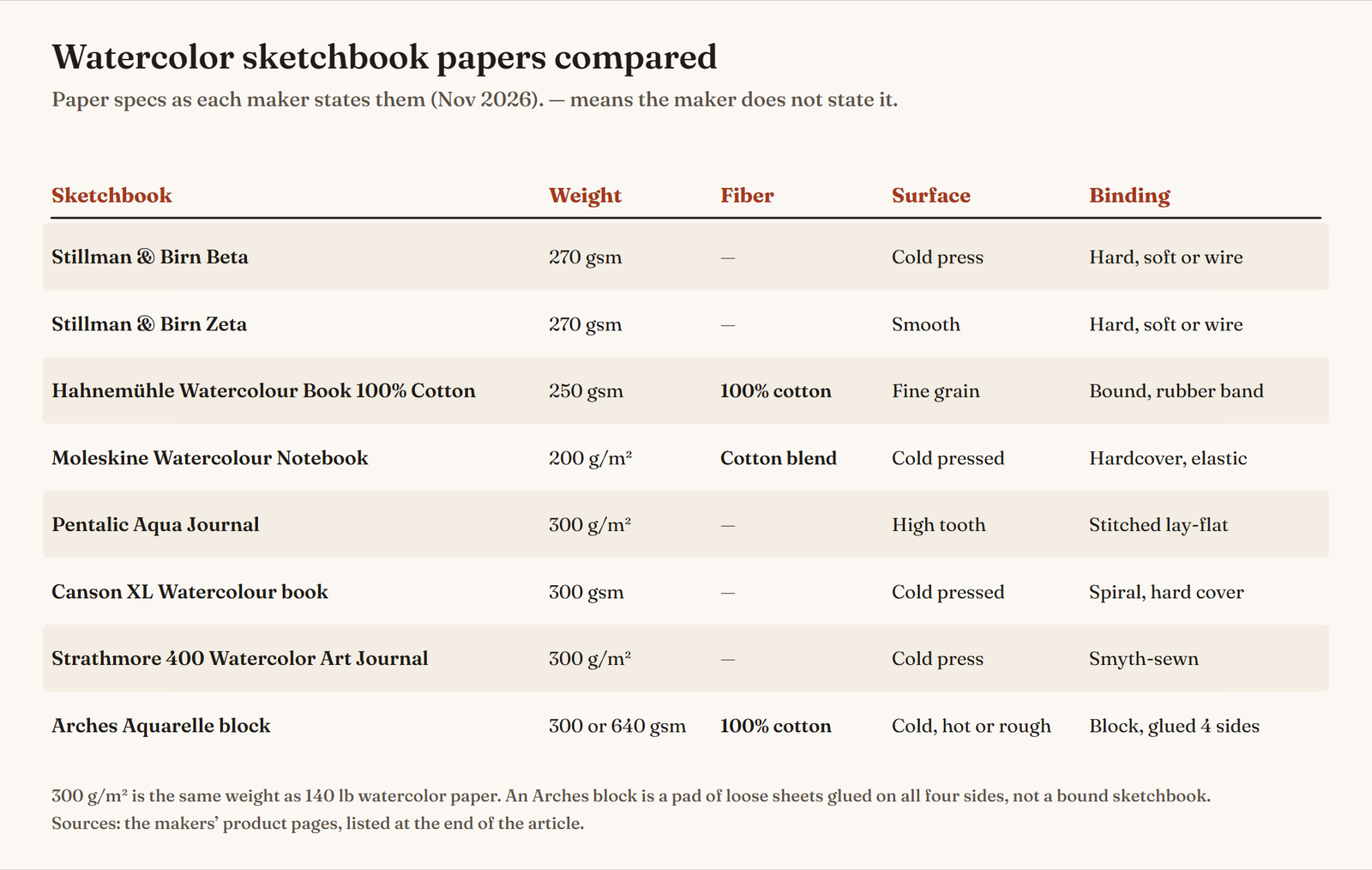
The best watercolor sketchbook is the one whose paper can take the water you put on it. That comes down to four things the makers state: paper weight, fiber (cotton or not), surface (hot press, cold press or rough) and binding. Our watercolor sketchbook recommendations below cover each need, from a cotton-paper book for serious painting to a budget book for practice, and every spec on this page comes from the maker’s own website, checked in November 2026. The comparison table at the top puts all eight side by side. (In British English, you’ll see it written as a watercolour sketchbook.)
We don’t show product photos here. The table and diagram are our own, built from the makers’ published specs.
How to choose a watercolor sketchbook
Good sketchbooks for watercolor have heavy paper, a surface that suits your painting, and a binding that lets the book lie flat. Start with these questions:
- How wet do you paint? For big, wet washes, choose 250 to 300 gsm paper. Lighter paper (around 200 gsm) suits quick sketches with light washes.
- Do you want cotton? Cotton paper takes layering, lifting and scrubbing better than most other papers. The Hahnemühle cotton book and Arches blocks state 100% cotton; Moleskine states a cotton blend.
- What surface? Cold press for most painting, smooth or hot press for ink and detail, rough for texture.
- Where will you paint? A small hardcover book travels well; a large journal gives you room for bigger studies.
A watercolor painting sketchbook is a compromise between a sketchbook and a sheet of watercolor paper. It’s lighter and more portable than a block, but the paper is usually thinner. For most artists, that trade is worth it for daily practice.
What the paper specs mean
Most makers describe watercolor paper with the same few terms:
- Weight (gsm or lb): grams per square meter. Heavier paper buckles less when wet. 300 g/m² is sold as 140 lb in the US, as Strathmore and Arches both state on their pages.
- Fiber: cotton (also called rag) or cellulose (wood pulp). Many makers don’t state the fiber of their sketchbook paper; our table shows a dash where they don’t.
- Surface: hot press, cold press or rough, explained below.
- Sizing and acid-free: sizing controls how the paper absorbs water; acid-free paper resists yellowing over time.
Hot press, cold press or rough?
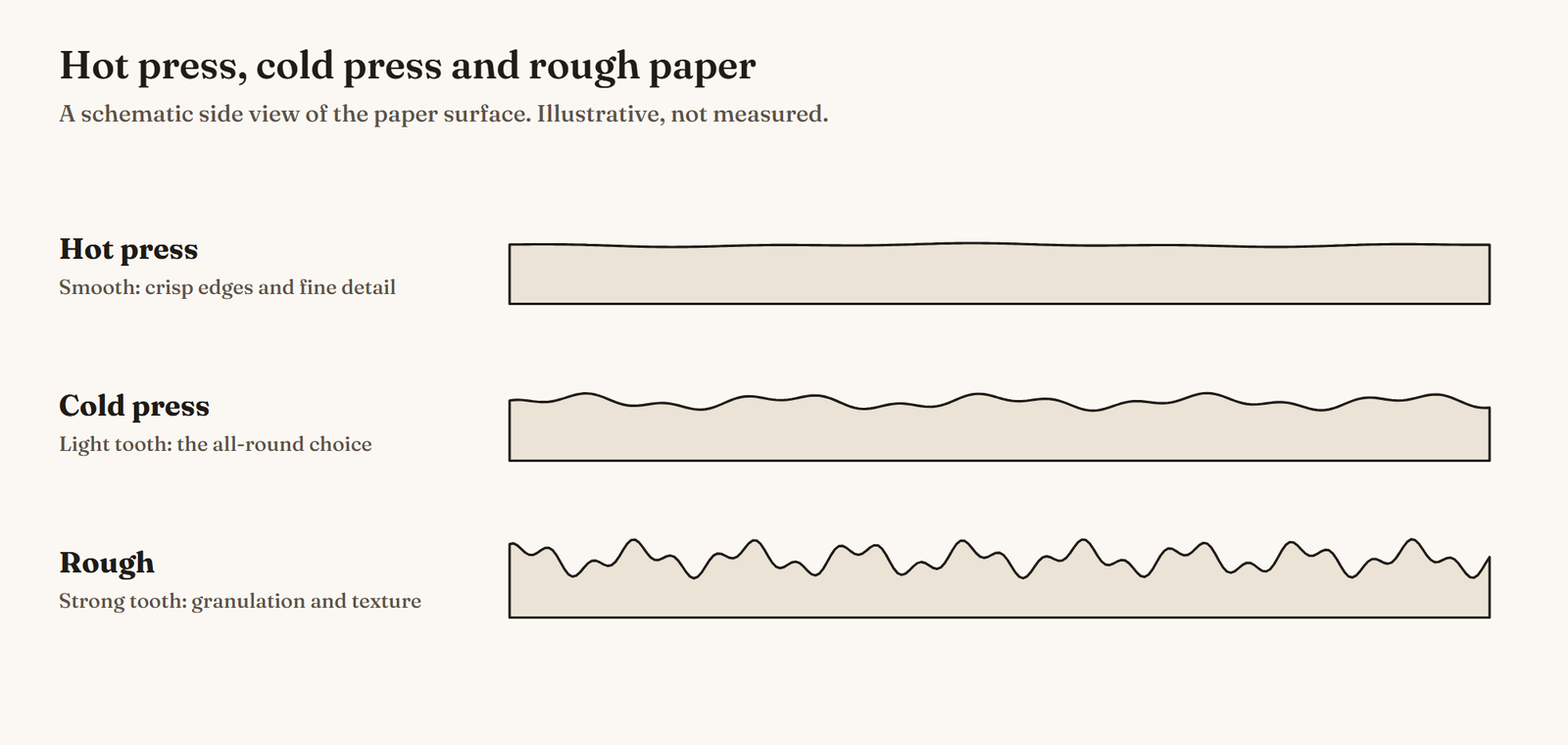
Cold press has a light tooth (texture) that holds pigment and gives washes a slightly grainy look. It’s the all-round choice, and most of the sketchbooks on this list use it: Stillman & Birn Beta, Moleskine, Canson XL and Strathmore 400.
Hot press is pressed smooth. Washes dry with crisper edges, fine detail is easier, and ink lines stay sharp. If you’re looking for a hot press watercolor sketchbook, the smooth Stillman & Birn Zeta is the closest pick here; Arches also sells hot-pressed blocks.
Rough has the strongest texture, good for granulating pigments and loose landscapes. It’s rare in sketchbooks; Arches offers it in blocks.
Sketchbook, pad or block?
Watercolor paper comes in three main formats, and each suits a different job:
- Sketchbook (bound): pages stay together, often lie flat, and let you paint across a two-page spread. Best for daily practice, travel and studies.
- Pad (spiral or glued on one edge): loose sheets you tear off. A watercolor sketch pad is cheap and handy for exercises, but the paper buckles because nothing holds it flat.
- Block (glued on all four sides): the paper stays flat while wet; you remove each sheet when the painting is dry. Arches states that its blocks hold 10 to 20 sheets.
If you want a watercolor paper sketchbook that behaves almost like loose sheets, choose a heavy paper with a lay-flat binding, such as the Pentalic Aqua Journal or Strathmore 400 journal.
Small or large?
A small watercolor sketchbook (A6 or A5, or around 5.5 x 8.5 in) fits in a bag with a travel paint set, so you’ll use it more often. A large watercolor sketchbook gives you space for bigger washes and more detailed studies but is harder to carry. Strathmore’s 400 Series journal comes as large as 11 x 14 in, and Hahnemühle’s cotton book ranges from A6 to A4, plus two square sizes.
Many painters keep two: a small book for daily sketches and a larger book or block for longer paintings.
Watercolor journals and notebooks
Watercolor journals combine a sketchbook with a diary: a page of painting, a few notes, a date. The best watercolor journals are small, sturdy and quick to open. The Moleskine Watercolour Notebook and the Pentalic Aqua Journal are both designed for this kind of carry-everywhere use, and Strathmore sells its 400 Series as an art journal. If you’re after a watercolor paint notebook for travel, look for a hard cover, an elastic or band closure and paper heavy enough for both sides.
Best watercolor sketchbook for beginners
Beginners need heavy paper more than expensive paper. A 300 gsm book at a low price tier, such as the Canson XL Watercolour book, lets you practice washes without fighting buckled pages. Once you know you enjoy watercolor, a cotton book like the Hahnemühle shows you how much the paper changes the result: colors stay brighter and you can lift and correct more easily.
The best sketchbook for pencil work is usually not a watercolor book. Textured watercolor paper gives pencil a grainy look. If you mostly draw and only sometimes paint, a mixed-media book such as the Stillman & Birn Beta or Zeta handles both better. Our guide to the best pencils for drawing covers the pencils themselves.
How to use a watercolor sketchbook
A few habits make any watercolor sketchbook work better:
- Tape or clip the pages you’re painting so they don’t lift while wet.
- Use less water than you think. Sketchbook paper is thinner than most sheets, so build color in layers.
- Let each page dry before you close the book, or slip a piece of scrap paper between pages.
- Swatch your colors on the first page so you know how each pigment behaves on this paper.
- Paint every day, even for ten minutes. A full sketchbook teaches more than one perfect painting; our guide to sketchbooking has ideas for filling the pages.
Learning watercolor
A sketchbook is where you practice; a good book or course shows you what to practice. When choosing the best books on watercolor, look for ones that teach washes, wet-in-wet, glazing and color mixing with exercises you can do in your sketchbook. If you’re still deciding which painting medium to learn, our comparison of oil painting and watercolors explains how the two differ, and our guide to drawing supplies covers the rest of a beginner’s kit.
Do you need cotton paper?
Not for every page. Cotton paper is more forgiving: it holds water longer, lets you lift color, and stands up to scrubbing. Hahnemühle and Arches both describe their cotton papers as made from 100% cotton. But many artists fill their daily sketchbooks with non-cotton paper and save cotton for paintings they plan to keep. Choose cotton when the painting matters, and a cheaper, heavy paper when the practice matters.
Frequently asked questions
What is the best watercolor sketchbook for beginners?
A sketchbook with heavy paper at a low price tier, such as the Canson XL Watercolour book (300 gsm), is a good start. Heavy paper buckles less, so early washes are easier to control.
What paper weight do you need for watercolor?
For sketchbooks, 250 to 300 gsm (about 140 lb at 300 gsm) handles washes well. Lighter paper, around 200 gsm, works for light washes and quick sketches but buckles more.
Is cotton paper worth it for a sketchbook?
Cotton paper is more forgiving: it handles repeated washes, lifting and scrubbing well. For practice and travel sketches, a cheaper heavy paper is often enough; save cotton for paintings you plan to keep.
Should you choose hot press or cold press?
Cold press is the all-round choice, with a light tooth that holds washes and texture. Hot press is smooth, better for fine detail and ink. Rough paper has the most texture.
Can you use a watercolor sketchbook for pencil drawing?
Yes. The textured surface gives pencil a grainy look, which many artists like. For smooth pencil work, a smooth paper such as the Stillman & Birn Zeta is a better fit.
Sources
- Beta Series sketchbooks (270 gsm, cold press, binding options), Stillman & Birn. Accessed .
- Zeta Series sketchbooks (270 gsm, smooth), Stillman & Birn. Accessed .
- Watercolour Book 100% Cotton (250 gsm, 30 sheets), Hahnemühle. Accessed .
- Watercolour Books overview, Hahnemühle. Accessed .
- Watercolour Notebook, Art Collection (200 g/m², cotton-blend), Moleskine. Accessed .
- Aqua Journal (140 lb / 300 g/m², 48 pages, lay-flat), Pentalic. Accessed .
- XL Book Watercolour (300 gsm, 34 sheets), Canson. Accessed .
- XL Watercolour (spiral binding, hard cover book), Canson. Accessed .
- 400 Series Watercolor Hardbound Art Journal (140 lb, Smyth-sewn), Strathmore. Accessed .
- 400 Series Watercolor Softcover Art Journal, Strathmore. Accessed .
- ARCHES Aquarelle (100% cotton; blocks glued on 4 sides), Arches. Accessed .
- ARCHES Aquarelle paper: block or pad?, Arches. Accessed .