How to Draw Every Day (and Actually Keep the Habit)
Part of Learn to Draw & Artist Life
Quick answer
To draw every day, make the habit tiny and automatic: pick a fixed time, attach it to something you already do, and set a minimum so small you can't fail (even two minutes). Time-box sessions, keep a list of prompts so you never wonder what to draw, track your days on a simple calendar, and treat bad drawings as part of the process. Never miss two days in a row.
Wanting to draw every day (or to draw everyday, as it’s often searched) is easy. Actually doing it, week after week, is the hard part. Most people start with enthusiasm, draw for an hour a day for a week, miss a day, then another, and quietly stop. The fix isn’t more willpower. It’s designing a habit that survives busy days, bad moods and bad drawings. Drawing every day is less about discipline than about design. This guide shows how to build a daily drawing practice that lasts: habit design, time-boxed routines, prompts, tracking, and what to do on the days your drawing “fails”. There’s a printable 30-day tracker below to get you started.
Don’t wait for motivation
Motivation is unreliable. Some days you’ll want to draw; many days you won’t. If daily drawing depends on feeling like it, it won’t happen daily.
Habits work differently. A habit is something you do because it’s what you do at that time, in that place, not because you feel inspired. Brushing your teeth doesn’t need motivation. The goal is to make drawing feel the same: automatic, small and expected.
Motivation often shows up after you start. Sit down, draw one line, and the second line is easier.
Design the habit
A daily drawing habit needs four things:
- A fixed time. Pick a time that’s realistic every day: after breakfast, on your lunch break, before bed.
- A trigger. Attach drawing to something you already do. “After I make my morning coffee, I open my sketchbook.”
- A tiny minimum. Decide the smallest session that still counts. Two minutes, or one drawing. On a terrible day, you only have to hit the minimum.
- A ready setup. Keep your sketchbook and pencil out where you’ll see them. Every bit of friction (finding supplies, choosing paper) is a reason to skip.
Use time-boxed routines
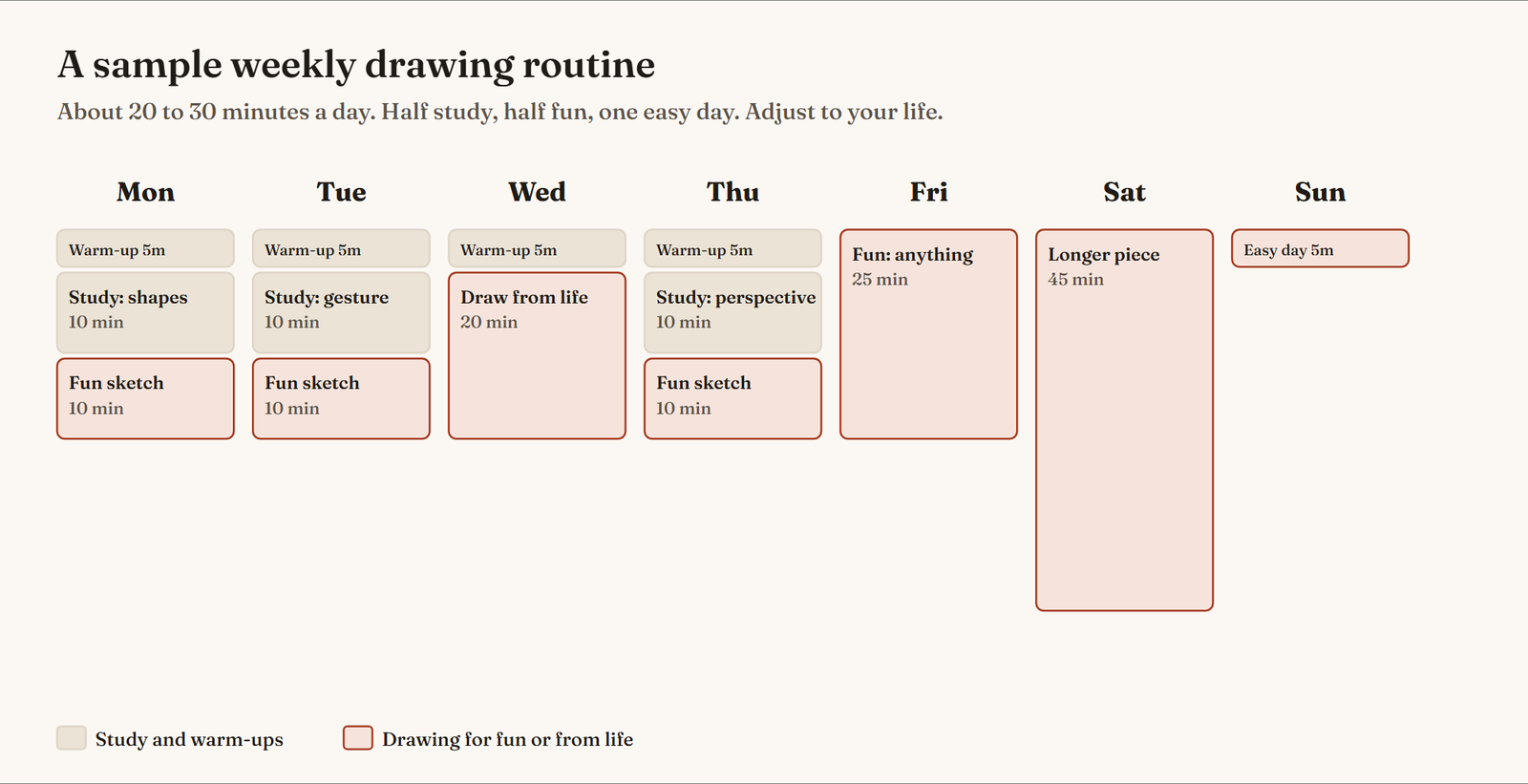
Open-ended sessions (“I’ll draw until I’m done”) are easy to put off. Time boxes are easier to start and easier to finish. The weekly routine at the top of this page is one example:
- Warm-up (5 minutes): lines, ellipses or quick gestures to loosen up.
- Study (10 minutes): one fundamental, such as shapes, gesture or perspective.
- Fun (10 minutes): anything you like.
- One longer session a week: for a bigger drawing you care about.
- One easy day: just the two-minute minimum, so you rest without breaking the chain.
Use a timer. When it rings, you can stop, guilt-free. Knowing there’s an end makes it much easier to begin.
Balance matters. If every session is study, drawing becomes a chore; if every session is fun, progress slows. Roughly half and half works for most people. Our guide on how to learn figure drawing includes a one-hour session plan if you want a longer, structured practice.
Never run out of ideas: daily drawing prompts
Deciding what to draw is a common reason people skip. Remove the decision by keeping a list of prompts, or browse our drawing ideas lists. Here are 20 to start with:
- Your breakfast.
- Your shoes, from three angles.
- The view from a window.
- A cup in five minutes, then in one minute.
- Your hand, holding something.
- Ten boxes in perspective.
- Twenty 30-second gesture drawings.
- A plant, focusing on leaf shapes.
- A character you invent in one minute.
- Someone on TV, paused.
- Your bag, emptied out.
- A self-portrait in a mirror.
- A street or room from memory.
- Three silhouettes of the same character.
- Something in your fridge.
- A cloud, then the same cloud as a creature.
- Your pet, or an animal from a video.
- A tool or gadget, as simple shapes.
- One object lit by a desk lamp.
- Whatever made you smile today.
How to draw yourself easily
Self-portraits are a great daily prompt because the model is always available. If you’ve wondered how to draw yourself easy and fast, sit facing a mirror with a single light from one side. Start with the big shapes: an egg for the head, a line through the eyes halfway down, a line for the nose and one for the mouth. Draw what you see, not what you think a face looks like. Don’t aim for flattery; aim for the shapes. Repeat it once a week and you’ll have a record of your progress, too.
For seasonal prompts, our list of summer drawing ideas has 63 more, and our planned guide to sketchbook ideas will add many more.
Track your days
Tracking turns an intention into a visible streak, and a streak is motivating in itself. Use the printable tracker below, a calendar on the wall, or a note on your phone. Tick a box every day you hit your minimum.
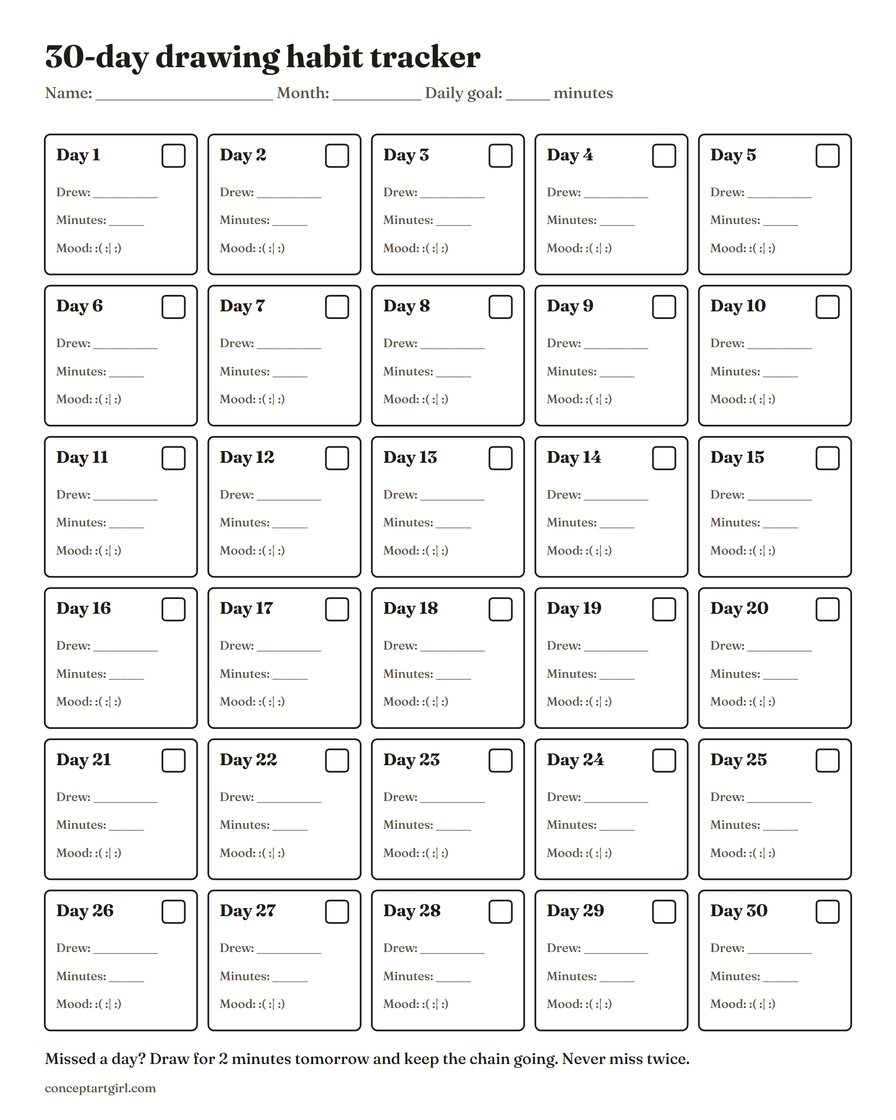
Download the printable 30-day drawing habit tracker (PNG). Each day has space for what you drew, how many minutes, and your mood, so after a month you can see what kind of drawing you enjoyed most.
Two tracking tips:
- Track the habit, not the quality. A box means you drew, not that the drawing was good.
- Date your drawings. Your sketchbook becomes a second tracker, and a record of progress.
Break big goals into daily steps
“Get good at drawing” is too big to act on. Break it down: a goal for the year (draw convincing figures), a focus for the month (gesture), and a daily step (twenty quick gestures). Small, specific steps are easier to start and easier to measure.
Some people like to turn this into a game: give yourself points for each session, “level up” after a week of streaks, or set small rewards for reaching 30 days. It sounds silly, but anything that makes the habit more fun makes it more likely to last.
Hold yourself accountable
A few ways to add a little outside pressure:
- Draw with someone. A friend, a family member or an online group doing the same challenge.
- Share daily. Post your drawing somewhere each day, even privately with one person.
- Join a challenge. Month-long themed drawing challenges are a common way to build momentum.
Accountability works best when it’s kind. The point is to keep going, not to feel judged.
When your drawing “fails”
Every artist has days when nothing works: proportions are off, lines are stiff, the drawing looks worse than last week’s. That’s normal, and it isn’t failure. A few things to remember:
- Bad drawings are part of the process. Every drawing teaches you something, often more when it goes wrong.
- Progress isn’t a straight line. Plateaus and bad weeks often come right before a jump in skill.
- Look back, not sideways. Compare your work with your own drawings from three months ago, not with artists who’ve been drawing for years.
- Change the task. If a study isn’t working, switch to something fun for the rest of the session. You still drew today.
On really hard days, just hit your minimum and stop. Keeping the habit alive matters more than any single drawing.
Keep it going
After a month, look back through your sketchbook and your tracker. Notice what you enjoyed, what improved and when you skipped. Adjust the routine: more time if it felt easy, a smaller minimum if it felt heavy, different prompts if you got bored. Then start the next 30 days.
Whether you draw daily for ten minutes or an hour, daily drawing is the engine behind everything else in learning art. If you want to know what to practice in those daily sessions, our guide on how to become an artist lays out the fundamentals in order, and our guide to sketchbooking shows how to fill a sketchbook without fearing the blank page.
Common mistakes
- Setting a goal of an hour a day from the start.
- Fix: Start with 10 to 20 minutes, and a two-minute minimum for busy days.
- Only drawing when you feel motivated.
- Fix: Draw at a fixed time, attached to an existing routine, whatever your mood.
- Throwing away drawings you don't like.
- Fix: Keep them, dated. They show your progress later.
- Treating one missed day as failure.
- Fix: Just draw tomorrow. Never miss twice in a row.
Frequently asked questions
Is it good to draw every day?
Yes. Short daily practice keeps skills fresh and builds steady progress. It doesn't need to be long; consistency matters more than session length.
How long should I draw each day?
Whatever you can sustain. Many people start with 10 to 30 minutes. On busy days, two minutes still keeps the habit alive.
What should I draw every day?
Mix study and fun: a short warm-up, one fundamental to practice, and something you enjoy. Keep a list of prompts, like the ones on this page, so you never have to decide on the spot.
What if I miss a day?
Draw the next day. One missed day doesn't break a habit; two or three in a row starts to. Lower the bar to two minutes until you're back on track.