Wizard Character Design: Ideas, Shape Language and Inspiration
Part of Character Design Gallery: Design Studies and Breakdowns
See the original work
Artist website
Official website
by John Howe
Canadian illustrator and concept designer, best known for his work on Peter Jackson's Lord of the Rings and Hobbit film trilogies.
See Official website on Artist website (opens in a new tab) ↗Official art book (HarperCollins)
The Lord of the Rings Sketchbook
by Alan Lee
English illustrator best known for his Tolkien artwork and for concept design on Peter Jackson's Lord of the Rings and Hobbit films.
See The Lord of the Rings Sketchbook on Official art book (HarperCollins) (opens in a new tab) ↗Cool wizard art works because a wizard is one of the easiest characters to read: a tall hat, a long robe and a staff say “magic” before you see a face. That makes the archetype a perfect study in character design. The hard part is making your wizard feel like someone, not just the default. This guide breaks wizard character design into the parts you can control (silhouette, shape language, costume, props and color) using our own diagrams. To see professional wizard concept art, follow the links to the artists’ official pages above; we link to their work instead of reposting it.
What makes wizard art work
Most memorable wizard artwork gets three things right:
- A clear silhouette. Hat, robe and staff create a shape you can recognize from across a room, or in a thumbnail.
- A costume that tells a story. Worn hems suggest a wanderer, rich trims a court magician, armor a battle mage.
- One idea pushed further than usual. A staff that’s twice the wizard’s height, sleeves that hide the hands, a hat that’s become a home for birds.
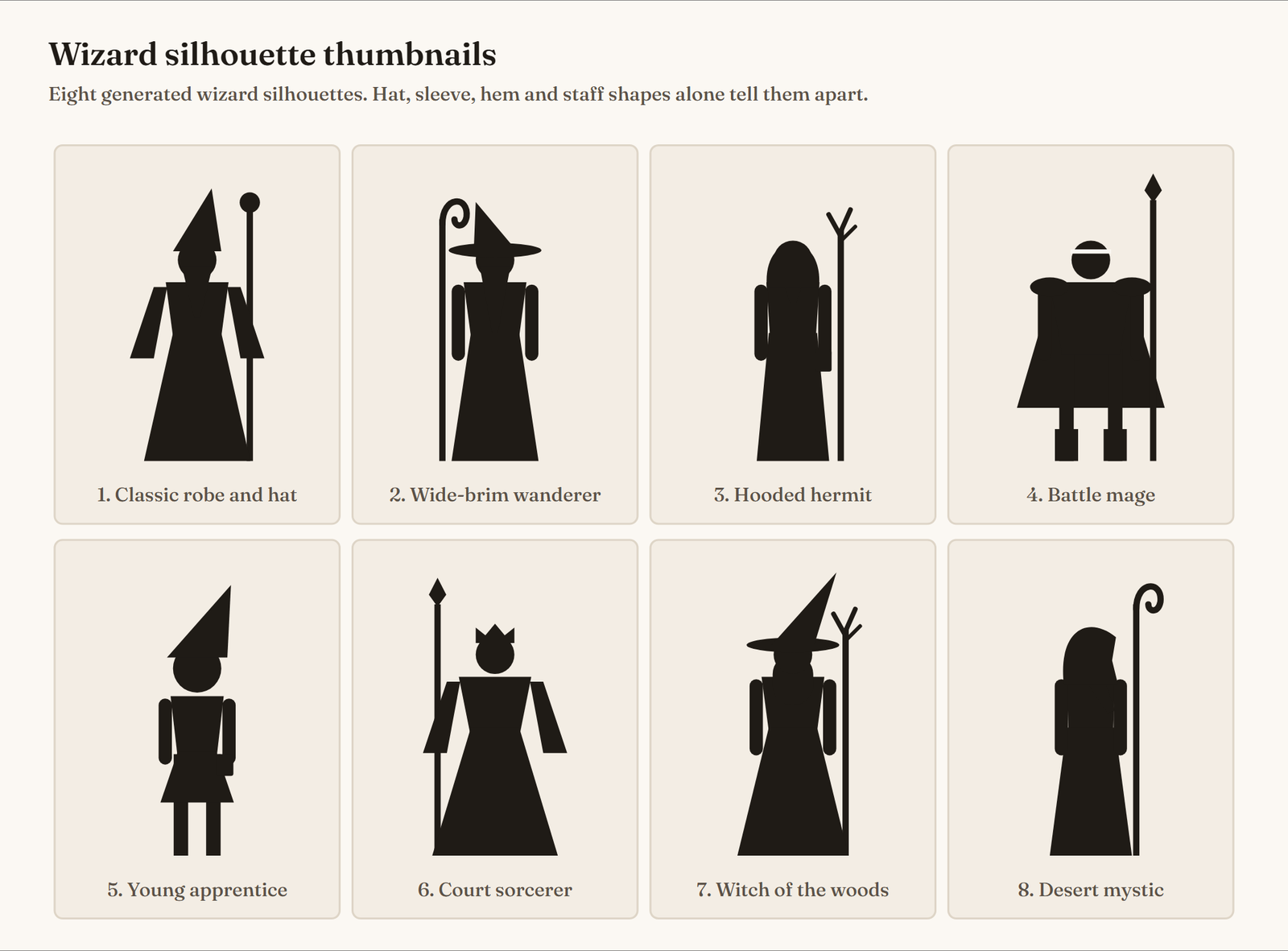
The silhouettes at the top of this page show how far you can push the archetype with simple shapes alone. Each one changes only the hat, the sleeves, the hem and the staff, yet they read as eight different characters.
Shape language for wizard characters
Shape language is the idea that basic shapes carry meaning: circles feel friendly and safe, triangles feel dynamic or dangerous, and squares feel stable and strong. Our guide to character design basics explains it in more depth. For wizards, it’s the fastest way to decide who your character is.
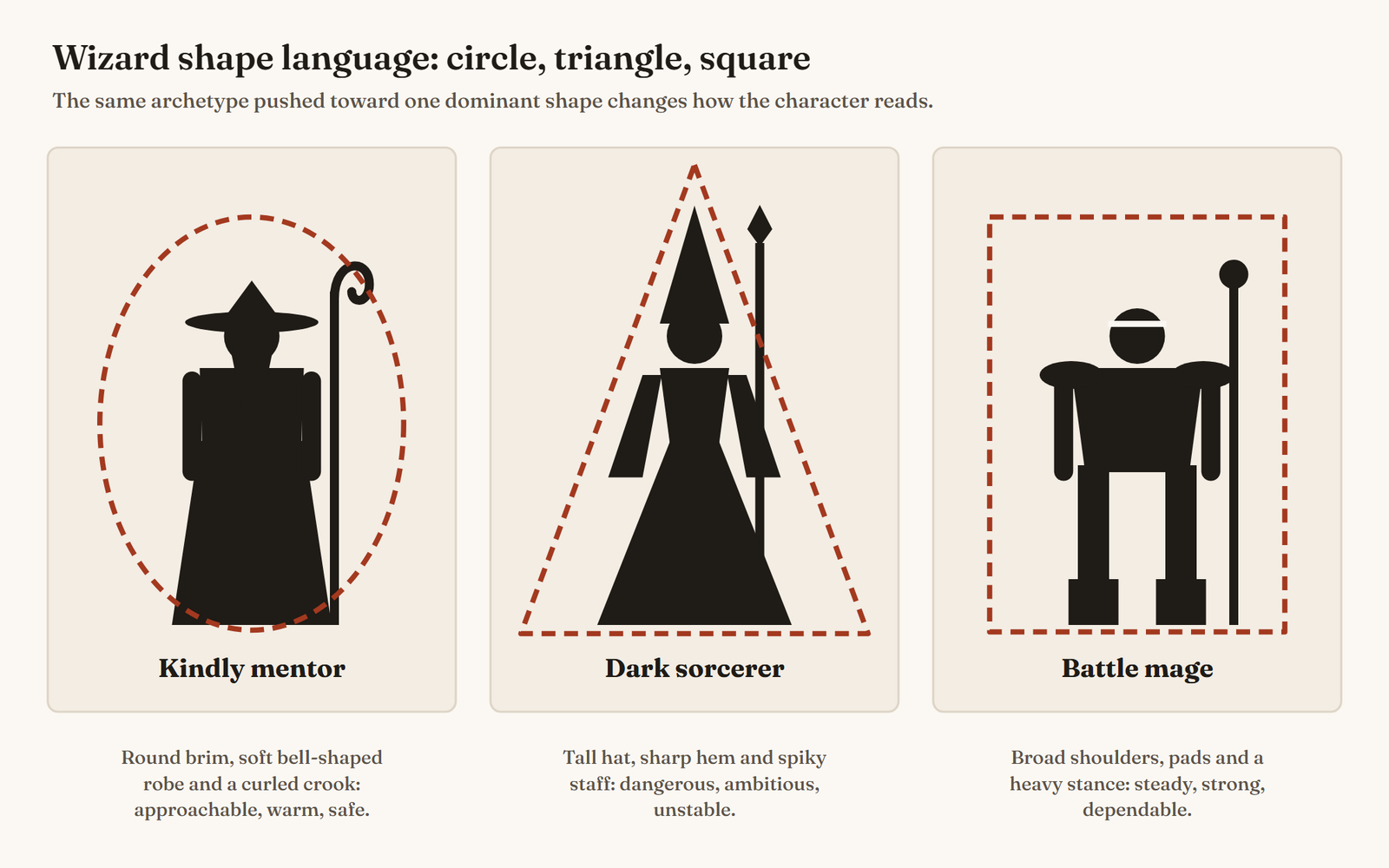
- Circle-based wizards have round brims, soft bell-shaped robes and curling staffs. They read as mentors, grandparents and kindly guides.
- Triangle-based wizards have tall pointed hats, narrow shoulders and flaring hems. They read as ambitious, mysterious or dangerous.
- Square-based wizards have broad shoulders, armor and a planted stance. They read as battle mages and protectors.
Pick one dominant shape and use the others as accents. A kindly wizard with one sharp element, such as a jagged crystal on the staff, hints at a hidden past.
The wizard costume: robe, hat, sleeves and staff
Before you draw any detail, block in the costume as big shapes over a figure. It keeps proportions honest and shows whether the design reads.
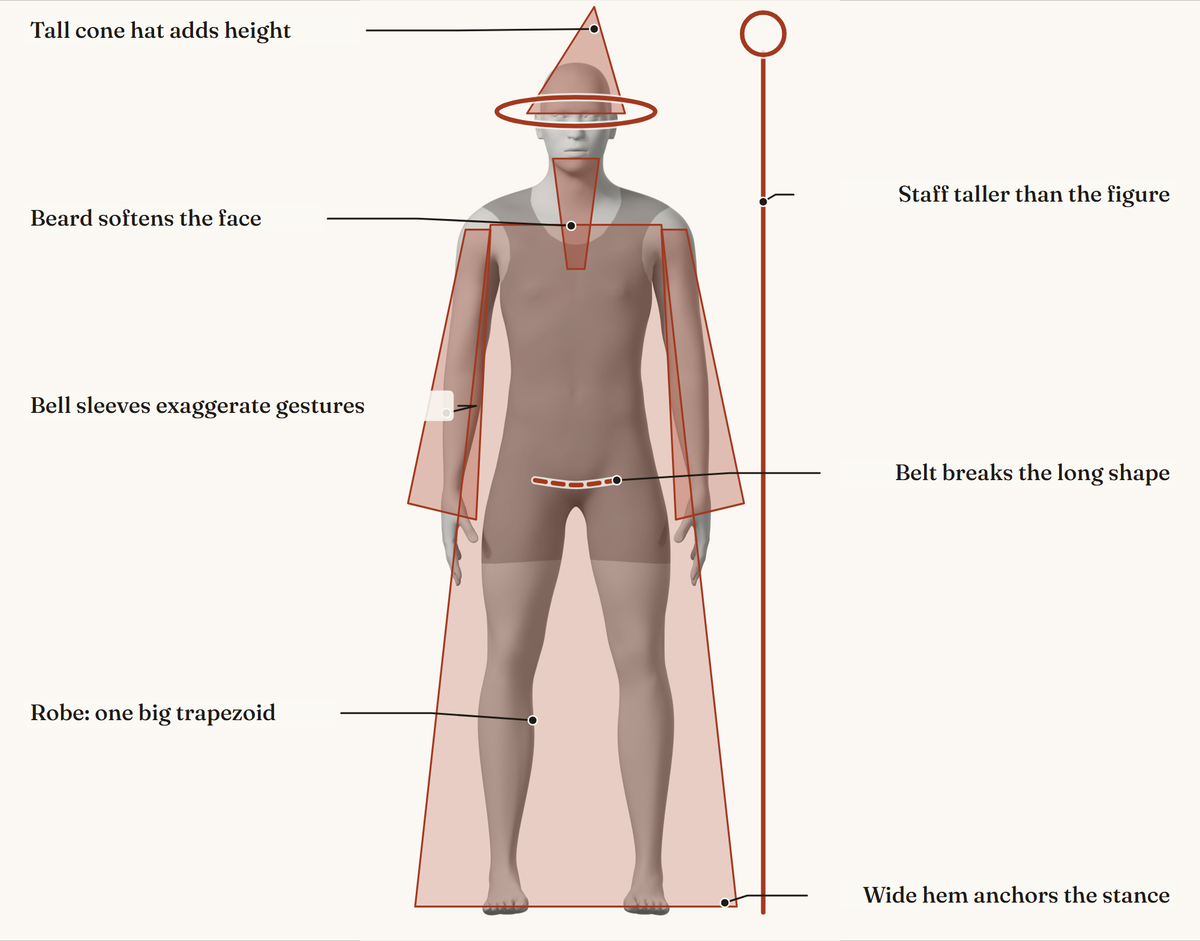
- The robe is usually one big trapezoid. A wider hem makes the figure feel grounded and old; a narrow hem makes it lighter and quicker.
- The hat adds height and personality. Tilt the tip, bend it, or swap it for a hood, a circlet or nothing at all.
- Bell sleeves exaggerate every gesture, which is useful for spellcasting poses.
- A belt or sash breaks the long vertical of the robe and gives you a place for pouches, books and charms.
- The staff is a second silhouette. Make it taller than the figure and it becomes part of the character’s outline.
Staffs and props: lessons from history
Real ceremonial objects are full of design ideas. A bishop’s crozier, the hooked staff carried in medieval church ceremonies, solves many of the same problems as a wizard’s staff: it must be recognizable from a distance, carry symbols and look important.
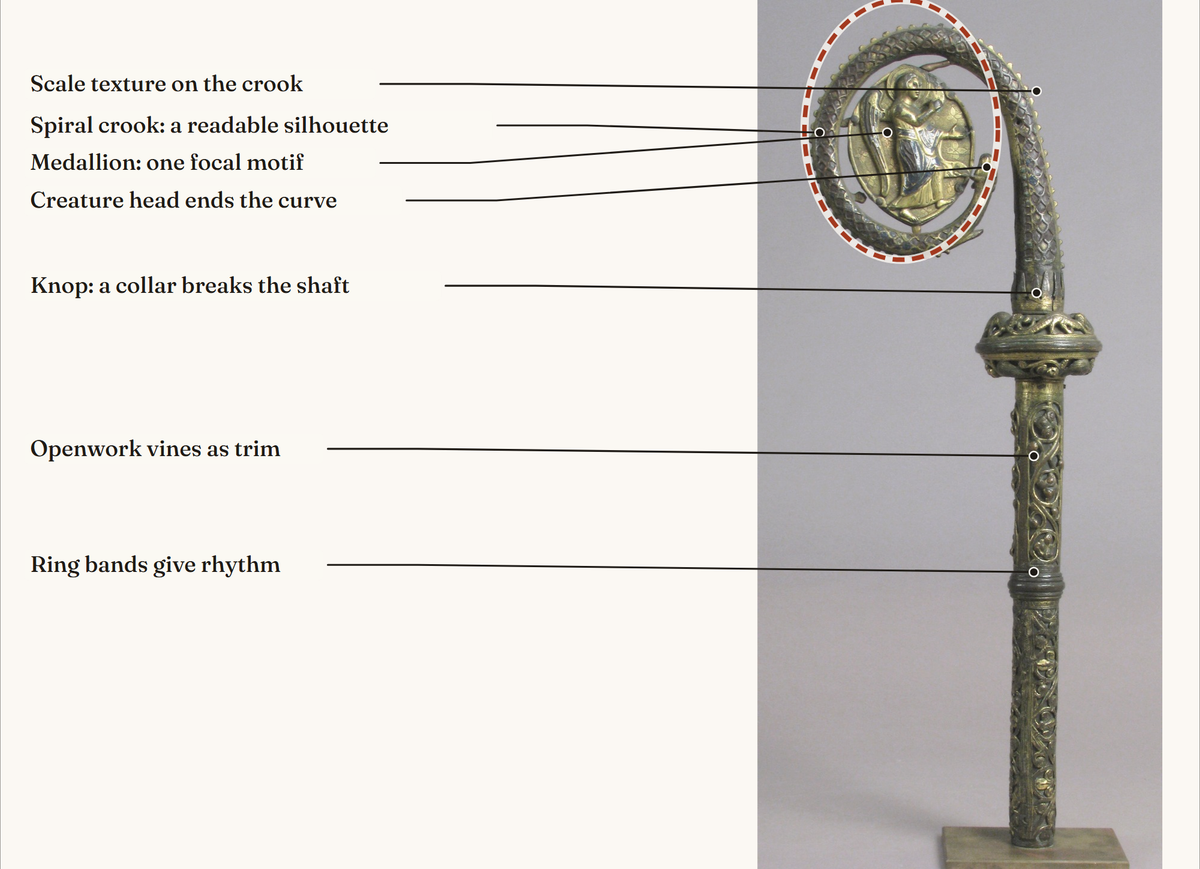
This 13th-century crozier head, released by The Met as public domain, shows several ideas you can borrow: a spiral crook that reads instantly as a silhouette, a single focal medallion inside the curve, a creature head that finishes the spiral, a textured surface, and collars and bands that break up a long shaft. Swap the medallion for a crystal, an eye or a caged flame, and you have a wizard’s staff with a believable history.
Color: example wizard palettes
Color tells the audience how to feel about your wizard before they know anything else. These three palettes were built for this page as examples:
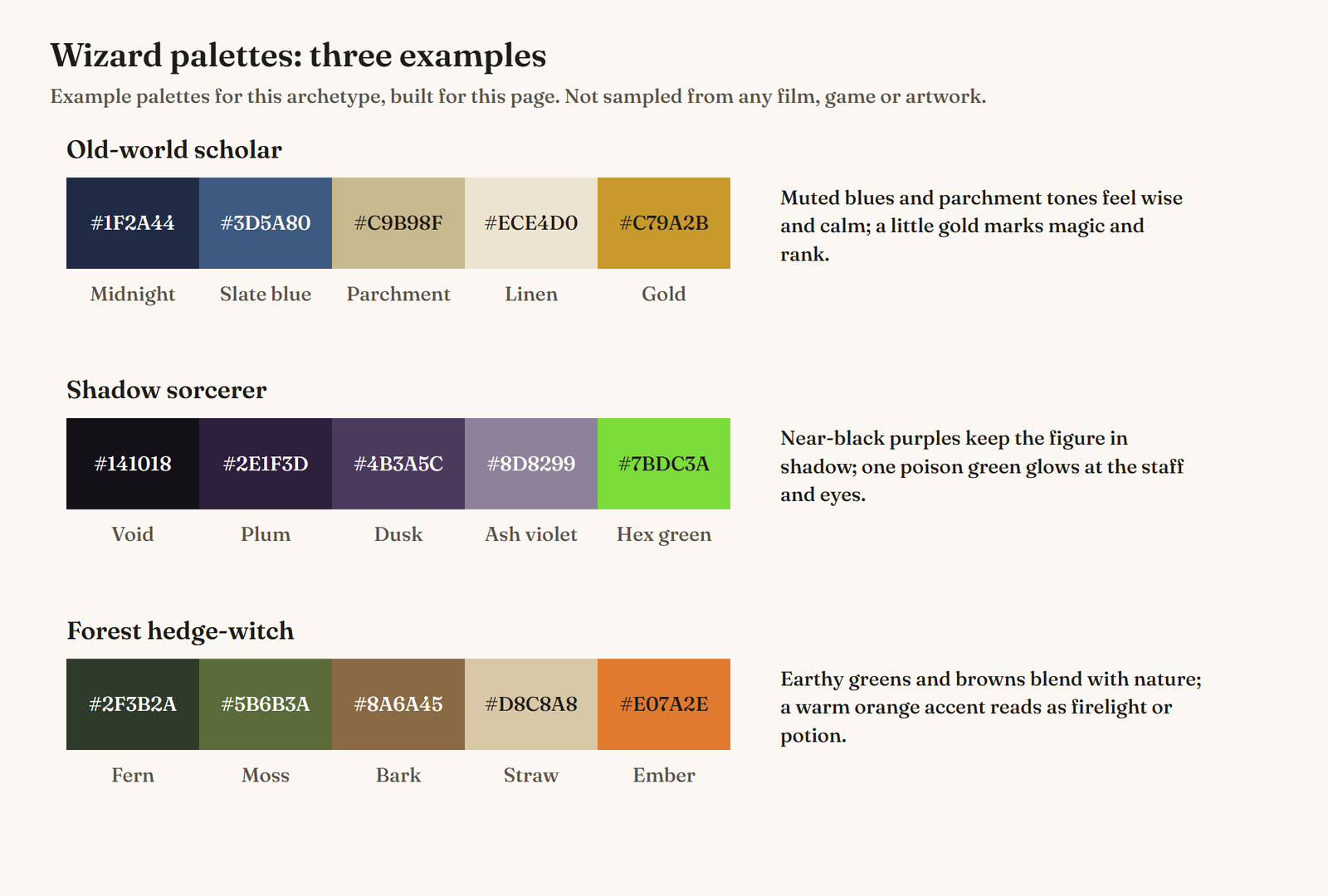
Keep most of the costume in one color family and save a small, saturated accent for the magic: a glowing staff, the eyes, or the inside of a sleeve. That accent will pull the viewer’s eye exactly where the story is.
Female wizard designs
Female wizard art often falls into two clichés: the pointed-hat witch and the glamorous sorceress. Both can work, but the archetype has far more room. Start from the same questions you’d ask for any wizard: Where does their magic come from? What do they carry? How old are they, and what have they survived? A field healer might wear practical layers with herb pouches; a scholar might wear ink-stained sleeves and reading glasses on a chain. Female wizard artwork that feels fresh usually comes from a specific life, not from a “female version” of a male design.
From wizard concept art to finished character art
Wizard concept art and finished wizard character art have different jobs. Concept art explores: many quick thumbnails, alternate hats and staffs, and callouts that explain how the costume works. Finished character art presents one final design in a polished illustration. In a typical workflow you move from silhouettes, to rough color, to a clean design sheet, then to a final illustration. If you want to follow that path, our guide to what a concept artist does explains the process in a studio.
Cool wizard drawings: quick exercises
Cool wizard drawings start with practice, not talent. Try these:
- Ten-minute silhouettes. Fill a page with small black wizard shapes. Don’t draw faces. Circle the three that read best.
- One wizard, three ages. Draw the same wizard as an apprentice, at their peak and in old age.
- Prop swap. Keep the body and robe, and change only the staff. Notice how much the character changes.
- Gesture first. Draw a spellcasting pose as a single line of action, then add the robe so it follows the motion.
A cool wizard drawing usually has one bold idea and a lot of restraint everywhere else.
Wizard fan art vs original designs
Wizard fan art is a great way to study how professionals solve design problems, but treat it as study: credit the original and don’t present it as your own design. To build your own portfolio, use what you learn to make original characters. The prompts below are a good start.
More cool character designs
Wizards are only one archetype. The same tools, silhouette, shape language, costume and color, work for every cool character design you’ll make. Explore more design studies in our design gallery, and start with the basics of character design if you’re new to the subject.
Design your own
- Design a wizard whose whole silhouette fits inside a circle. Make them kind without giving them a beard.
- Design a wizard who is afraid of their own magic. Show it in the posture and the costume.
- Turn a historical staff, such as a bishop's crozier, into a wizard's focus. Keep the silhouette, change the meaning.
- Design a battle mage whose armor and robe tell you which side of the magic war they're on.
- Design a female wizard without a pointed hat, a robe or a staff. What still says 'wizard'?
- Design an apprentice and their master as a pair: same palette, opposite shapes.
- Design a desert wizard whose clothing protects them from sun and sand.
- Design a wizard whose magic comes from books. Where do they carry them?
- Draw eight wizard silhouettes in ten minutes, then finish the one you can name at a glance.
- Redesign a classic robe-and-hat wizard for a world with modern technology.